
Slushie machines are not one-size-fits-all appliances. They are designed in multiple types because the way slush drinks are prepared, served, and consumed varies widely across different environments. A machine that works perfectly for home use may struggle in a busy café, while a high-output commercial unit would be unnecessary and impractical for personal use. These differences in demand, performance expectations, and operating conditions are the main reason slushie machines are available in so many distinct types.
As explained in The Ultimate Slushie Machine Guide, choosing the right machine starts with understanding how different designs serve different needs. One of the most important factors influencing the type of slushie machine is volume requirements. Machines built for high-traffic locations must produce large quantities continuously, while low-volume machines focus on convenience and ease of use.
Another key distinction is commercial versus home use, as commercial machines are engineered for durability, food-safety compliance, and continuous operation, whereas home models prioritize simplicity, compact size, and affordability. Freezing technology also plays a major role in machine design, affecting texture consistency, freezing speed, energy efficiency, and maintenance requirements. In addition, the desired drink variety—such as single-flavor slushies, multiple flavors, frozen cocktails, or multi-drink options—directly influences the machine’s structure, bowl configuration, and control systems.
Understanding these factors helps narrow down the correct type of slushie machine and ensures better performance, longer equipment life, and a smoother serving experience.
- Classification of Slushie Machines
- Types of Slushie Machines Based on Freezing Technology
- Types of Slushie Machines Based on Usage
- Types of Slushie Machines Based on Tank Design
- Types of Slushie Machines Based on Cooling Mechanism
- Portable vs Countertop vs Floor-Standing Slushie Machines
- Specialty Slushie Machine Types
- How to Choose the Right Type of Slushie Machine
- Common Mistakes When Choosing Slushie Machine Types
- Frequently Asked Questions (FAQs)
Classification of Slushie Machines
Slushie machines can be classified in several distinct ways, each focusing on a specific aspect of how the machine functions and where it is best used. These classifications help readers quickly understand the differences between machine types before exploring each category in detail.
1. Freezing Technology
This classification is based on how a slushie machine freezes and maintains the slush mixture. Different freezing systems influence ice crystal formation, texture consistency, freezing speed, and overall energy efficiency. The freezing method also affects how much maintenance the machine requires over time.
2. Usage Environment
Slushie machines are commonly categorized according to where they are intended to be used. Home machines are designed for occasional, low-volume use, while commercial machines are built for continuous operation in cafés, shops, and food-service environments. High-output models serve locations with heavy daily demand.
3. Capacity and Tank Design
Another major way to categorize slushie machines is by their capacity and bowl configuration. Machines may feature single, twin, or multiple tanks, each offering different serving volumes and flavor options. Tank size and layout also impact space requirements and refilling frequency.
4. Cooling Mechanism
This category focuses on how the machine removes heat from the system. Slushie machines typically use air-cooled or water-cooled mechanisms, which affect installation needs, performance in warm climates, and operating efficiency.
5. Mobility and Installation
Slushie machines can also be classified based on how they are installed and moved. Some models are portable and suitable for temporary setups or events, while others are countertop or floor-standing units designed for permanent or semi-permanent installation.
Types of Slushie Machines Based on Freezing Technology
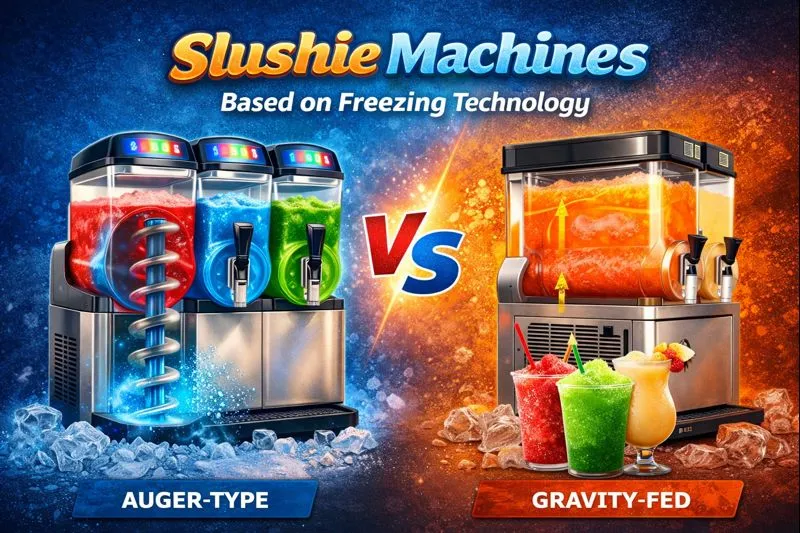
The way a slushie machine freezes liquid is one of the most important factors affecting drink quality, texture, and performance. There are two primary freezing technologies used in slushie machines: gravity-fed systems and auger-based systems. Each system has its unique mechanism, benefits, and limitations.
Gravity-Fed Slushie Machines
How They Work
Gravity-fed machines rely on a simple design where the liquid mixture flows downward naturally into a freezing chamber. Ice crystals form as the mixture cools, and stirring is minimal or completely absent. The slush mixture is then dispensed by gravity into cups when the tap is opened.
| Best For |
|---|
| Convenience stores and gas stations |
| Locations with medium to high customer flow but limited need for perfectly uniform texture |
Pros & Cons
-
Simple design with fewer moving parts
-
Lower maintenance requirements
-
Generally, more energy-efficient
-
Lower initial cost
-
Texture consistency may vary over time
-
Limited control over slush thickness
-
May not perform well for complex drink recipes
Auger-Based Slushie Machines
How They Work
Auger-based machines use a mechanical screw (auger) inside the freezing cylinder to continuously stir the slush mixture. This agitation prevents large ice crystals from forming, maintaining a smooth and uniform texture throughout. Auger machines often feature multiple bowls and advanced temperature controls.
| Best For |
|---|
| High-traffic commercial locations |
| Cafés, restaurants, or any setup requiring consistent texture |
| Locations offering multiple flavors or frozen cocktails |
Pros & Cons
-
Superior texture control and consistency
-
Supports high-volume continuous operation
-
Ideal for premium-quality slush drinks
-
Mechanically more complex
-
Higher maintenance requirements
-
Typically more expensive upfront and in energy use
Comparison: Gravity-Fed vs Auger-Based Machines
| Feature | Gravity-Fed | Auger-Based |
|---|---|---|
| Texture Consistency | Medium | High |
| Maintenance | Low | Medium |
| Commercial Suitability | Medium–High | High |
| Energy Efficiency | High | Medium |
| Price Range | Lower | Higher |
| Flavor Variety | Limited | Multiple |
Key Takeaways
- Gravity-fed machines are simple, affordable, and effective for medium-demand settings but offer less control over texture.
- Auger-based machines provide superior consistency and support high-volume operations, but they are more complex and costly.
- Choosing the right freezing technology is essential to match volume requirements, desired drink quality, and maintenance capacity.
Types of Slushie Machines Based on Usage
Slushie machines are also classified based on where and how they are used. The main categories are home machines, commercial machines, and industrial/high-output machines. Understanding the usage environment helps determine capacity, durability, and features needed for optimal performance.
Home Slushie Machines
Overview
Home slushie machines are designed for convenience, compactness, and ease of use. They typically have smaller tanks (1–2 liters), simple controls, and low power consumption. They are perfect for families, small gatherings, or casual entertaining.
| Best For |
|---|
| Personal use at home |
| Small parties or events |
| Occasional beverage service |
Pros & Cons
-
Compact and portable
-
Easy to clean and maintain
-
Affordable price range
-
Simple plug-and-play operation
-
Low output volume
-
Limited to a single or a few flavors
-
Not suitable for continuous use or commercial settings
Commercial Slushie Machines
Overview
Commercial machines are built for heavy-duty use, continuous operation, and high customer traffic. They feature larger tanks, more powerful compressors, and often multiple bowls for offering several flavors simultaneously. Compliance with food safety regulations is also a key consideration.
| Best For |
|---|
| Cafés, restaurants, and snack bars |
| Convenience stores and kiosks |
| Movie theaters and entertainment venues |
Pros & Cons
-
High-volume output
-
Durable components for continuous operation
-
Multi-flavor options available
-
Consistent texture
-
Higher upfront cost
-
Requires more space
-
Maintenance and cleaning are more involved
Industrial / High-Output Slushie Machines
Overview
Industrial machines are designed for locations with extremely high demand, such as stadiums, theme parks, and large beverage chains. These machines often feature multiple bowls, very large tanks, and dedicated electrical setups. They prioritize performance, reliability, and high hourly output over portability.
| Best For |
|---|
| Large-scale commercial operations |
| Venues serving hundreds of customers per day |
| Operations requiring continuous, high-speed production |
Pros & Cons
-
Maximum serving capacity
-
Multiple flavor and bowl options
-
Built for continuous, heavy-duty use
-
Very high cost
-
Requires dedicated space and installation
-
Complex maintenance and specialized servicing
Key Takeaways
- Home machines: Compact, convenient, ideal for low-volume, casual use.
- Commercial machines: Balance of durability, volume, and flavor variety for medium to high traffic locations.
- Industrial/high-output machines: Maximum capacity, designed for continuous operation in very high-demand environments.
Choosing a machine based on usage ensures proper performance, reduces maintenance issues, and prevents overpaying for unnecessary features.
Types of Slushie Machines Based on Tank Design
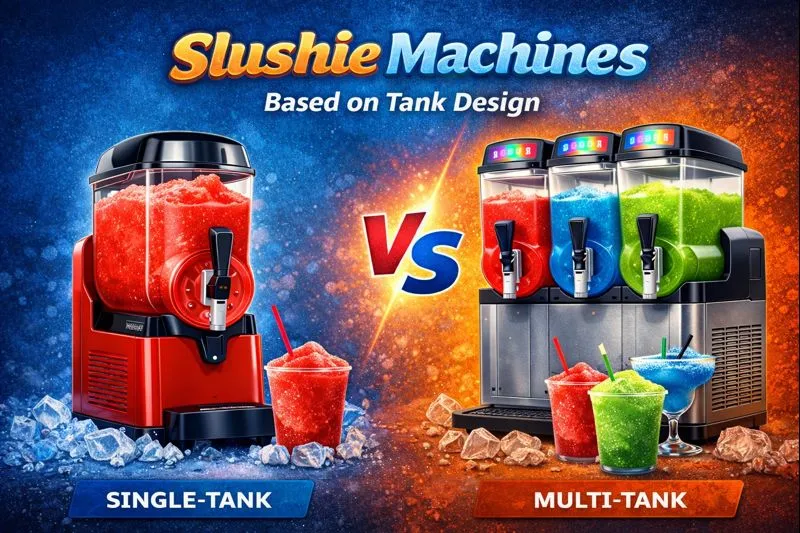
The tank design of a slushie machine directly affects how many drinks it can produce, how many flavors can be offered, and how efficiently the machine operates during peak hours. Slushie machines are most commonly categorized by the number of bowls or tanks they contain, with each configuration serving different operational needs.
Single-Bowl Slushie Machines
Overview
Single-bowl slushie machines feature one freezing tank designed to hold and dispense a single flavor at a time. These machines are typically compact and straightforward, making them a popular choice for small spaces and low-demand environments.
| Best For |
|---|
| Home users |
| Small cafés and kiosks |
| Businesses offering one signature slush drink |
Pros & Cons
-
Compact footprint
-
Lower energy consumption
-
Easier cleaning and maintenance
-
More affordable than multi-bowl machines
-
Limited to one flavor
-
Requires frequent refilling in busy environments
-
Not ideal for peak-hour commercial demand
Twin-Bowl Slushie Machines
Overview
Twin-bowl machines are designed with two independent freezing tanks, allowing operators to serve two different flavors simultaneously. Each bowl usually has its own temperature control, providing better flexibility and menu variety.
| Best For |
|---|
| Cafés and dessert shops |
| Convenience stores |
| Medium-traffic commercial locations |
Pros & Cons
-
Ability to offer flavor variety
-
Balanced output and space usage
-
Suitable for moderate customer flow
-
Requires more counter space
-
Higher power consumption than single-bowl models
-
Increased cleaning time
Triple & Multi-Bowl Slushie Machines
Overview
Triple and multi-bowl slushie machines feature three or more tanks and are built for high-volume, high-variety service. These machines are commonly used in entertainment venues where customers expect multiple flavor options at all times.
| Best For |
|---|
| Cinemas and shopping malls |
| Amusement parks |
| High-traffic beverage outlets |
Pros & Cons
-
Maximum flavor variety
-
High serving capacity
-
Reduced refilling during peak hours
-
Large physical footprint
-
Higher initial investment
-
Increased maintenance and energy usage
Comparison: Slushie Machines by Tank Configuration
| Tank Design | Flavor Options | Space Required | Output Capacity | Typical Users |
|---|---|---|---|---|
| Single-Bowl | 1 | Low | Low–Medium | Home, small kiosks |
| Twin-Bowl | 2 | Medium | Medium | Cafés, stores |
| Multi-Bowl | 3–4+ | High | High | Cinemas, malls |
Key Takeaways
- Single-bowl machines are ideal for simplicity and limited menus.
- Twin-bowl machines offer flexibility and balanced performance.
- Multi-bowl machines are designed for maximum variety and high demand.
Tank design should be chosen based on available space, customer volume, and the number of flavors you plan to offer.
Types of Slushie Machines Based on Cooling Mechanism
The cooling mechanism determines how efficiently a slushie machine removes heat during operation. This classification is especially important for performance in hot climates and locations with limited ventilation.
Air-Cooled Slushie Machines
Overview
Air-cooled slushie machines use internal fans to dissipate heat into the surrounding air. They are the most common type due to their simple installation and lower upfront cost.
| Best For |
|---|
| Indoor locations with good airflow |
| Small to medium commercial setups |
| Home and countertop installations |
Pros & Cons
-
Easier installation
-
No plumbing required
-
Lower purchase cost
-
Performance affected by high ambient temperatures
-
Requires adequate ventilation space
-
May be less efficient in hot environments
Water-Cooled Slushie Machines
Overview
Water-cooled machines use a water circulation system to remove heat more efficiently. These machines are often used in high-demand or hot-climate environments where air cooling may struggle.
| Best For |
|---|
| High-temperature regions |
| Enclosed or poorly ventilated spaces |
| High-output commercial operations |
Pros & Cons
-
Superior cooling performance
-
Stable operation in hot conditions
-
Often quieter than air-cooled models
-
Requires water supply and drainage
-
Higher installation complexity
-
Increased water usage
Key Takeaways
- Air-cooled machines are cost-effective and easy to install but require proper ventilation.
- Water-cooled machines provide consistent performance in demanding environments but need plumbing support.
Portable vs Countertop vs Floor-Standing Slushie Machines
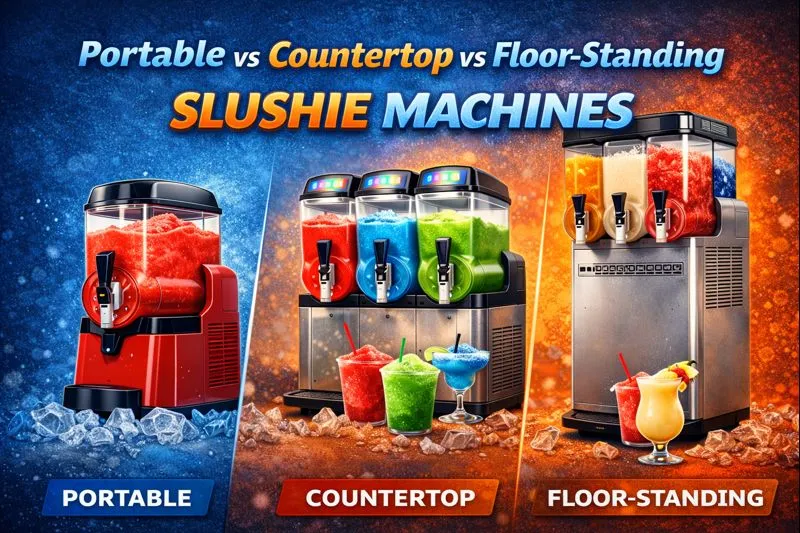
Slushie machines can also be classified based on how they are installed and moved. This distinction is especially important when space, mobility, and long-term placement are key considerations. Choosing the right installation type ensures efficient workflow, better space utilization, and smoother daily operation.
Portable Slushie Machines
Overview
Portable slushie machines are lightweight, compact units designed to be easily moved from one location to another. They usually feature smaller tanks and simplified freezing systems, making them ideal for temporary setups or low-volume use.
| Best For |
|---|
| Outdoor events and parties |
| Temporary stalls and pop-up shops |
| Home users needing occasional portability |
Pros & Cons
-
Easy to transport and store
-
Minimal installation requirements
-
Suitable for short-term or seasonal use
-
Limited capacity and output
-
Not designed for continuous operation
-
Fewer advanced features
Countertop Slushie Machines
Overview
Countertop slushie machines are the most common type used in both small commercial environments and some high-end home setups. They are designed to sit on counters or work surfaces and offer a balance between capacity, performance, and space efficiency.
| Best For |
|---|
| Cafés and dessert shops |
| Convenience stores |
| Restaurants with limited floor space |
Pros & Cons
-
Moderate to high output
-
Fits easily into existing workspaces
-
Available in single or multi-bowl configurations
-
Requires sturdy counter support
-
Limited expansion compared to floor-standing units
-
Ventilation space still required
Floor-Standing Slushie Machines
Overview
Floor-standing slushie machines are large, high-capacity units designed for permanent installation. These machines often feature multiple bowls, powerful compressors, and robust cooling systems to handle heavy daily demand.
| Best For |
|---|
| Cinemas and malls |
| Theme parks and stadiums |
| High-volume beverage outlets |
Pros & Cons
-
Highest output capacity
-
Multiple flavor options
-
Designed for continuous, long-term use
-
Requires significant floor space
-
Higher purchase and installation cost
-
Not easily movable
Comparison: Installation and Mobility Types
| Type | Mobility | Capacity | Space Requirement | Typical Use |
|---|---|---|---|---|
| Portable | High | Low | Minimal | Events, home |
| Countertop | Medium | Medium | Counter space | Cafés, shops |
| Floor-Standing | Low | High | Floor space | Cinemas, malls |
Key Takeaways
- Portable machines prioritize flexibility and convenience.
- Countertop machines offer the best balance for most businesses.
- Floor-standing machines are ideal for high-volume, permanent setups.
Selecting the right installation type depends on available space, daily serving volume, and whether mobility is required.
Specialty Slushie Machine Types
Beyond standard slushie machines, there are specialty models designed for specific drink types or expanded beverage menus. These machines offer advanced controls, specialized freezing capabilities, and greater versatility, making them ideal for businesses looking to differentiate their offerings.
Frozen Cocktail & Alcohol Slushie Machines
Overview
Frozen cocktail and alcohol slushie machines are specially engineered to handle beverages containing alcohol. Because alcohol has a lower freezing point than non-alcoholic liquids, these machines use precise temperature controls and stronger freezing systems to achieve the right slush consistency without over-freezing or separation.
Key Features
- Advanced temperature and viscosity controls
- Stronger compressors for low-freezing-point liquids
- Optimized mixing to prevent separation
| Best For |
|---|
| Bars and lounges |
| Restaurants offering frozen cocktails |
| Event venues serving alcoholic slush drinks |
Pros & Cons
-
Consistent frozen cocktail texture
-
Ability to serve margaritas, daiquiris, and other alcohol-based slush drinks
-
Enhances beverage menu appeal
-
Higher cost than standard slushie machines
-
Requires careful recipe formulation
-
Often restricted to commercial use
Multi-Drink Combination Machines
Overview
Multi-drink combination machines are designed to produce more than just slushies. These machines can often prepare slush drinks, smoothies, frozen lemonades, and sometimes cold beverages, all from the same unit.
Key Features
- Adjustable temperature settings
- Multiple drink modes
- Versatile tank configurations
| Best For |
|---|
| Cafés and juice bars |
| Businesses with limited equipment space |
| Locations wanting menu flexibility |
Pros & Cons
-
High versatility
-
Reduced need for multiple machines
-
Efficient use of counter or floor space
-
May not specialize in one drink type
-
Higher learning curve for operators
-
Maintenance can be more complex
Key Takeaways
- Frozen cocktail machines are essential for alcohol-based slush drinks that require precise freezing control.
- Multi-drink machines offer flexibility for businesses serving a wide range of frozen beverages.
- Specialty machines are ideal when standard slushie machines cannot meet specific drink or menu requirements.
How to Choose the Right Type of Slushie Machine
Choosing the right type of slushie machine is not just about price or brand—it’s about matching the machine’s capabilities with your actual operating requirements. The wrong choice can lead to poor performance, high maintenance costs, or wasted investment. The following factors should be carefully evaluated before selecting a slushie machine.
1. Daily Serving Volume
Daily serving volume is one of the most critical decision factors. It determines the machine’s required capacity, freezing power, and durability.
- Low volume (1–30 servings/day):
Home or small countertop machines with single bowls are usually sufficient. - Medium volume (30–150 servings/day):
Commercial countertop machines with twin bowls provide balanced output and reliability. - High volume (150+ servings/day):
Floor-standing or industrial machines with multiple bowls and continuous-duty compressors are necessary.
Underestimating volume often leads to frequent refilling, slow freezing, and equipment wear.
2. Available Space
Physical space plays a major role in selecting the machine type. Machines vary greatly in size, ventilation needs, and installation requirements.
- Limited space:
Portable or single-bowl countertop machines are best. - Moderate counter space:
Twin-bowl countertop machines offer good performance without excessive footprint. - Large floor space:
Floor-standing machines allow high output and multiple flavors.
Always consider:
- Clearance for ventilation
- Access for cleaning and maintenance
- Power outlet and drainage positioning
3. Climate and Ambient Temperature
Climate directly affects machine performance, especially in warm or humid environments.
- Cool or climate-controlled locations:
Air-cooled machines typically perform well. - Hot climates or poorly ventilated spaces:
Water-cooled machines maintain consistent freezing and prevent overheating.
In hot regions, choosing the wrong cooling system can lead to slow freezing, uneven texture, and compressor strain.
4. Drink Variety and Menu Requirements
The number and type of drinks you plan to serve should guide your machine selection.
- Single-flavor menus:
Single-bowl machines are cost-effective and efficient. - Multiple flavors:
Twin or multi-bowl machines allow better menu variety. - Specialty drinks:
Frozen cocktail or multi-drink machines are required for alcohol-based or mixed beverage menus.
Offering more flavors can increase sales but also requires more cleaning and management.
5. Maintenance Capability
Maintenance requirements vary significantly between machine types and technologies.
- Low maintenance preference:
Gravity-fed and single-bowl machines are easier to clean and service. - Advanced operation capability:
Auger-based and multi-bowl machines require regular cleaning and technical understanding.
Consider:
- Cleaning frequency
- Availability of replacement parts
- Access to service technicians
Choosing a machine beyond your maintenance capability can increase downtime and costs.
6. Budget and Total Cost of Ownership
Budget should be evaluated beyond the initial purchase price.
- Lower budget:
Home or basic commercial machines with fewer features. - Mid-range budget:
Durable commercial countertop machines with multiple bowls. - High budget:
Industrial or specialty machines with advanced features.
Also factor in:
- Energy consumption
- Water usage (for water-cooled machines)
- Maintenance and repair costs
A higher upfront investment often results in better performance and longer lifespan.
Summary for Quick Decision
| Factor | Best Choice Impact |
|---|---|
| Daily Volume | Determines size & duty cycle |
| Space | Controls installation type |
| Climate | Influences cooling system |
| Drink Variety | Defines bowl count & specialty type |
| Maintenance | Affects reliability & downtime |
| Budget | Guides long-term value |
Key Takeaways
- Match machine type to actual usage needs, not assumptions.
- Consider long-term operating conditions, not just purchase price.
- A well-matched machine delivers better performance, lower costs, and higher customer satisfaction.
Common Mistakes When Choosing Slushie Machine Types
Even after understanding the different types of slushie machines, many buyers still make costly mistakes that affect performance, operating costs, and overall satisfaction. Avoiding the following common errors can save time, money, and frustration in the long run.
(a) Buying Commercial Machines for Home Use
One of the most common mistakes buyers make is purchasing commercial slushie machines for home use. Commercial machines are built for continuous operation, high output, and strict food-service environments. While they may appear more powerful and durable, they are often oversized, consume more electricity, and require more maintenance than a typical home setup can handle. For most households, this results in unnecessary costs, space issues, and a machine that is far more complex than needed.
(b) Ignoring Power Requirements
Power requirements are frequently overlooked when selecting a slushie machine. Many commercial and industrial machines require higher voltage, dedicated circuits, or specific electrical configurations. Ignoring these requirements can lead to tripped breakers, unsafe installations, or the inability to operate the machine at all. In some cases, buyers only realize after purchase that their existing electrical system cannot support the machine, leading to additional installation expenses.
(c) Overlooking Ventilation Needs
Proper ventilation is essential for slushie machine performance, especially for air-cooled models. When machines are placed in enclosed or poorly ventilated spaces, heat cannot dissipate effectively. This results in slower freezing, inconsistent slush texture, and increased strain on internal components. Over time, poor ventilation can significantly reduce the lifespan of the machine and increase the risk of mechanical failure.
(d) Underestimating Maintenance Requirements
Many buyers underestimate the level of maintenance required to keep a slushie machine operating efficiently. Machines with multiple bowls, auger systems, or specialty functions require regular and thorough cleaning to maintain hygiene and performance. Failing to account for this can lead to product buildup, poor drink quality, increased downtime, and higher repair costs—particularly in commercial environments where machines are used daily.
Frequently Asked Questions (FAQs)
What type of slushie machine is best for home use?
For home use, compact slushie machines designed specifically for low-volume operation are the best choice. These machines typically feature single bowls, simple controls, and lower power requirements. They are easy to clean, affordable, and well-suited for occasional use without the complexity of commercial-grade equipment.
Are gravity-fed slushie machines better than auger-based machines?
Neither type is universally better—it depends on the intended use. Gravity-fed machines are simpler, more energy-efficient, and easier to maintain, making them ideal for medium-demand retail environments. Auger-based machines provide superior texture consistency and are better suited for high-volume or premium beverage operations where uniform quality is essential.
Can one slushie machine make multiple types of drinks?
Yes, some slushie machines are designed to handle multiple drink types. Multi-drink or specialty machines can prepare slushies, frozen lemonades, smoothies, and even frozen cocktails. However, these machines require precise temperature control and proper recipes to ensure consistent results across different beverages.
Which type of slushie machine works best in hot climates?
In hot climates or poorly ventilated spaces, water-cooled slushie machines generally perform better than air-cooled models. They maintain stable freezing temperatures and reduce the risk of overheating, making them more reliable in high ambient temperatures.
Conclusion
Slushie machines are available in many different types because serving requirements, environments, and beverage goals vary widely. Whether the focus is freezing technology, usage level, tank configuration, cooling method, or installation style, each classification plays a critical role in how well a machine performs in real-world conditions.
Selecting the right type of slushie machine is not just about features—it’s about aligning the machine with daily serving volume, available space, climate, maintenance capability, and budget. When these factors are carefully considered, the result is better drink quality, smoother operation, and a longer equipment lifespan.
For readers who want to go deeper, exploring detailed slushie machine reviews can help compare real-world performance across different models. Those still narrowing their options may benefit from step-by-step buying guides that break down features, pricing, and use cases. You can also browse individual product pages to see specifications, capacities, and suitability for specific environments.
Taking the time to explore these resources makes it easier to choose a slushie machine that truly fits your needs—whether for home enjoyment or commercial success.