You’ve poured syrup into your slush machine, switched it on with high expectations, and waited—only to find a watery drink spinning endlessly instead of turning into that perfect icy slush. This is one of the most common and frustrating issues slush machine users face, whether at home or in a commercial setup.
When slush doesn’t form, it wastes time, syrup, electricity, and patience. Customers complain, kids lose excitement, and business owners risk losing sales. Many people assume the machine is faulty, but in most cases, the real problem is much simpler—and completely avoidable.
The truth is, slush not forming is usually caused by incorrect syrup ratios. Whether you’re using standard slush syrup, soda, or alcohol, the sugar content (Brix level) must be just right for freezing to happen. In this article, we’ll break down why slush fails to form, explain normal syrup, soda, and alcohol ratios, and show you the actual ideal ratios for consistent, perfect slush every time.
- Understand How Slush Forms
- 1. Slush Not Forming with Normal Syrup Ratio
- 2. Slush Not Forming with Soda-Based Drinks
- 3. Slush Not Forming with Alcohol-Based Mixtures
- Comparing Ratios at a Glance
- Additional Factors That Affect Slush Formation
- How to Fix Slush That Is Already Not Forming
- Prevention Tips for Perfect Slush Every Time
- Final Thoughts
Understand How Slush Forms
Before diving into ratios, it’s important to understand why ratios matter.
A slush machine works by freezing liquid while continuously stirring it. The liquid must contain enough sugar to prevent solid ice, but not so much sugar that it refuses to freeze at all. Sugar lowers the freezing point of liquid. Too little sugar = solid ice. Too much sugar = no freezing.
This balance is measured as Brix, which refers to the percentage of sugar in a solution.
- Ideal slush Brix range: 12–14%
- Below 10%: Over-freezing or ice buildup
- Above 15%: Slush will not freeze properly
Incorrect syrup ratios throw this balance off, which is why slush doesn’t form even when the machine seems to be working fine.
1. Slush Not Forming with Normal Syrup Ratio
Why It Happens
Standard slush syrups are concentrates, designed to be mixed with water at a specific ratio. The most common mistake users make is either:
- Adding too much syrup (too sweet)
- Adding too much water (too diluted)
When the syrup-to-water ratio is wrong, the sugar concentration moves outside the ideal freezing range.
Common Wrong Assumptions
Many users believe:
- “More syrup = better flavor”
- “Thicker liquid will freeze faster”
Both assumptions are incorrect. Excess syrup raises the sugar content so high that the freezing cylinder cannot bring the temperature low enough to form slush.
Ideal Syrup Ratio for Slush Machines
The industry-standard ratio for most commercial and home slush syrups is:
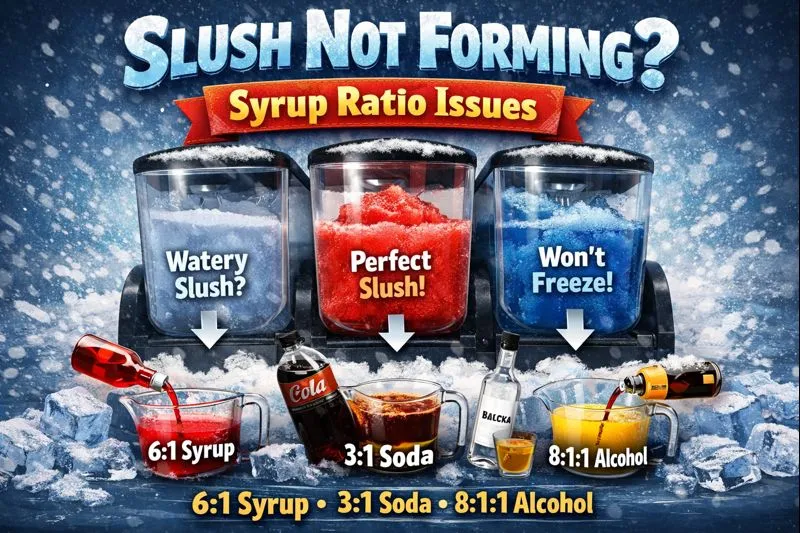
6:1 Ratio (Water : Syrup)
- 6 parts water
- 1 part syrup
This ratio usually produces a Brix level of around 12–13%, which is ideal for slush formation.
Always mix outside the machine to ensure even consistency before pouring it into the barrel.
Signs the Syrup Ratio Is Incorrect
- Slush remains liquid after 45–60 minutes
- Machine runs continuously without freezing
- Mixture looks glossy and overly thick
- No ice crystals forming on the barrel wall
If you notice these signs, drain the mixture and remix using the correct 6:1 ratio.
2. Slush Not Forming with Soda-Based Drinks
Why Soda Is Tricky
Soda introduces two extra challenges:
- High sugar content
- Carbonation
Most sodas already contain a large amount of sugar, often higher than slush syrup when mixed incorrectly. On top of that, carbonation interferes with freezing and must be released before use.
Common Soda Ratio Mistakes
- Pouring soda directly into the machine without dilution
- Using regular soda instead of syrup-based soda concentrate
- Not letting carbonation settle before freezing
This results in:
- Under-freezing
- Excess foam
- Inconsistent texture
Ideal Soda Ratio for Slush Formation
For soda-based slush, the recommended ratio is:
2.5:1 or 3:1 (Water : Soda)
Best Practice:
- Use flat soda (remove carbonation by stirring or letting it rest)
- Dilute properly before adding to the machine
This lowers the sugar content into the acceptable freezing range and allows the machine to create slush instead of liquid.
Using Soda Syrup Instead of Bottled Soda
If you’re using soda fountain syrup, follow this ratio:
5:1 Ratio (Water : Soda Syrup)
This is similar to standard slush syrup and produces more consistent results than bottled soda.
3. Slush Not Forming with Alcohol-Based Mixtures
Why Alcohol Is the Most Common Failure Point
Alcohol is the biggest enemy of slush formation because it dramatically lowers freezing point. The higher the alcohol percentage, the harder it is for the machine to freeze the mixture.
Many users assume:
- “If it freezes in my freezer, it will freeze in the slush machine”
This is incorrect. Slush machines operate at controlled temperatures and are not designed to freeze high-alcohol liquids.
Common Alcohol Ratio Problems
- Adding straight spirits (vodka, rum, whiskey)
- Using wine or liqueurs without dilution
- Estimating alcohol quantity instead of measuring
Even small mistakes can stop slush from forming entirely.
Ideal Alcohol Ratio for Slush Machines
To successfully make alcoholic slush, you must limit alcohol content to 3–5% ABV in the final mixture.
Recommended Alcohol Slush Ratio
8:1:1 Ratio
- 8 parts water or juice
- 1 part syrup
- 1 part alcohol
This keeps the sugar and alcohol levels within a range that allows freezing.
Best Alcohol Choices for Slush
- Vodka (lowest flavor interference)
- White rum
- Tequila (in small amounts)
Avoid:
- Whiskey
- High-proof spirits
- Cream-based liqueurs
Comparing Ratios at a Glance
| Drink Type | Correct Ratio | Key Rule |
|---|---|---|
| Standard Slush Syrup | 6:1 (Water : Syrup) | Most reliable |
| Soda (Bottled) | 3:1 (Water : Soda) | Remove carbonation |
| Soda Syrup | 5:1 (Water : Syrup) | Better consistency |
| Alcohol Slush | 8:1:1 (Water : Syrup : Alcohol) | Keep ABV under 5% |
Additional Factors That Affect Slush Formation
Even with perfect ratios, slush may still struggle if these issues exist:
Temperature Settings
- Ideal freezing range: -2°C to -5°C
- Too warm = liquid
- Too cold = solid ice
Mixing Quality
- Always pre-mix ingredients
- Uneven sugar distribution causes inconsistent freezing
Overfilling the Barrel
- Fill only to the recommended level
- Overfilling reduces cooling efficiency
Machine Warm-Up Time
- Slush formation can take 30–60 minutes
- Alcohol mixtures may take longer
How to Fix Slush That Is Already Not Forming
- Turn off the machine
- Drain the mixture completely
- Measure ingredients accurately
- Remix using correct ratio
- Clean the barrel if residue is present
- Restart and allow full freeze cycle
Never try to “fix” a bad mix by adding water or syrup directly into the machine while running.
Prevention Tips for Perfect Slush Every Time
- Always follow manufacturer-recommended ratios
- Use measuring cups, not guesswork
- Label pre-mixed batches for consistency
- Avoid experimenting in the machine
- Keep a ratio chart near the equipment
For commercial use, consistent ratios also protect the cooling system and extend machine lifespan.
Final Thoughts
Slush not forming is rarely a machine failure—it’s almost always a ratio issue. Whether you’re working with normal syrup, soda, or alcohol, the balance between sugar, water, and freezing temperature must be precise. By understanding the science behind slush formation and following the correct ratios—6:1 for syrup, 3:1 for soda, and 8:1:1 for alcohol—you can eliminate guesswork and achieve smooth, frozen slush every time.
Get the ratio right, and your slush machine will do the rest.