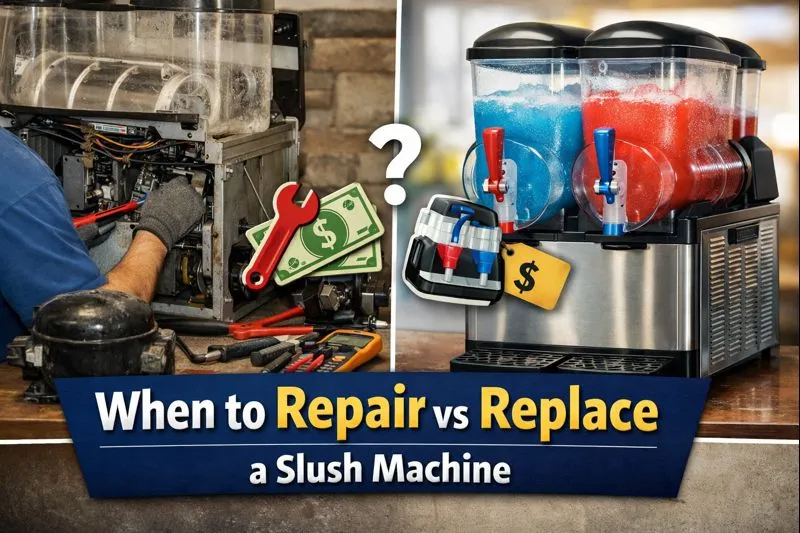
Your slush machine stops freezing properly, makes unusual noise, or leaks syrup just when business is good. Now you are stuck with a tough decision—should you repair the machine or replace it with a new one?
Frequent breakdowns not only increase repair bills but also cause downtime, lost sales, unhappy customers, and hygiene concerns. On the other hand, buying a new slush machine feels expensive, especially if the old one still “kind of works.” Making the wrong choice can cost more in the long run.
The smart decision comes from comparing repair cost vs new machine cost. This guide will help you understand when repairing your slush machine makes sense and when replacement is the better, more cost-effective option.
Understanding the Real Cost of Repair
Repairing a slush machine is often the first choice, especially for minor problems. But the real cost is more than just the technician’s bill.
Common Repair Costs
- Minor fixes (seals, tap leakage, filter cleaning, fan issues): Low cost
- Medium repairs (thermostat, condenser fan, motor issues): Moderate cost
- Major repairs (compressor, cooling system failure, refrigeration unit): High cost
A general rule many technicians follow is:
If repair cost is more than 40–50% of the price of a new machine, replacement should be considered.
Hidden Repair Expenses
- Repeated service calls
- Downtime and lost beverage sales
- Higher electricity usage due to poor efficiency
- Short-term fixes that don’t last
If your slush machine needs repairs frequently, the total cost over a year may exceed the price of a new unit.
When Repairing a Slush Machine Makes Sense
Repair is usually the better choice when the machine is still relatively new and the issue is limited.
Choose Repair If:
- The machine is less than 3–4 years old
- The problem is minor or occasional
- Repair cost is under 30–40% of a new machine
- Parts are easily available
- The machine still freezes properly after repair
Examples:
- Replacing worn seals or taps
- Cleaning a blocked condenser coil
- Fixing airflow or fan issues
In these cases, repair extends the machine’s life at a reasonable cost.
When Replacing a Slush Machine Is the Better Option
Sometimes replacement is not an expense—it’s an investment.
Choose Replacement If:
- The machine is old (5–7+ years)
- Repair cost is 50% or more of a new machine
- Compressor or refrigeration system fails
- Breakdowns happen frequently
- Energy bills are increasing
- Hygiene and safety standards are hard to maintain
Older machines are less efficient, struggle to maintain consistency, and often underfreeze drinks. Even after repair, performance may not fully recover.
Repair Cost vs New Machine Cost: A Simple Comparison
| Factor | Repair | Replacement |
|---|---|---|
| Upfront cost | Lower | Higher |
| Long-term reliability | Uncertain | High |
| Energy efficiency | Usually lower | Much better |
| Downtime risk | Higher | Minimal |
| Warranty | No / Limited | Full warranty |
| Performance | May decline | Optimal |
If repairs keep piling up, replacement usually wins in the long term.
The Efficiency and Performance Factor
New slush machines offer:
- Better cooling cycles
- Consistent texture and viscosity
- Faster freezing time
- Lower electricity consumption
- Improved hygiene and safety features
Even if a repair seems cheaper today, poor efficiency can silently increase monthly operating costs.
A Practical Decision Formula
Ask yourself these questions:
- Is the repair cost less than 40% of a new machine?
- Is the machine still reliable after repair?
- Will it meet your business demand for the next 2–3 years?
If you answer “no” to two or more, replacement is usually the smarter choice.
You might also like: Slushie Machine Buying Checklist
Final Verdict
Repairing a slush machine is ideal for small, infrequent issues in newer machines. But when repair costs rise, breakdowns become common, or performance drops, replacing the machine saves money, time, and stress in the long run.
By focusing on repair cost vs new machine cost, you can make a clear, confident decision that protects both your budget and your business performance.