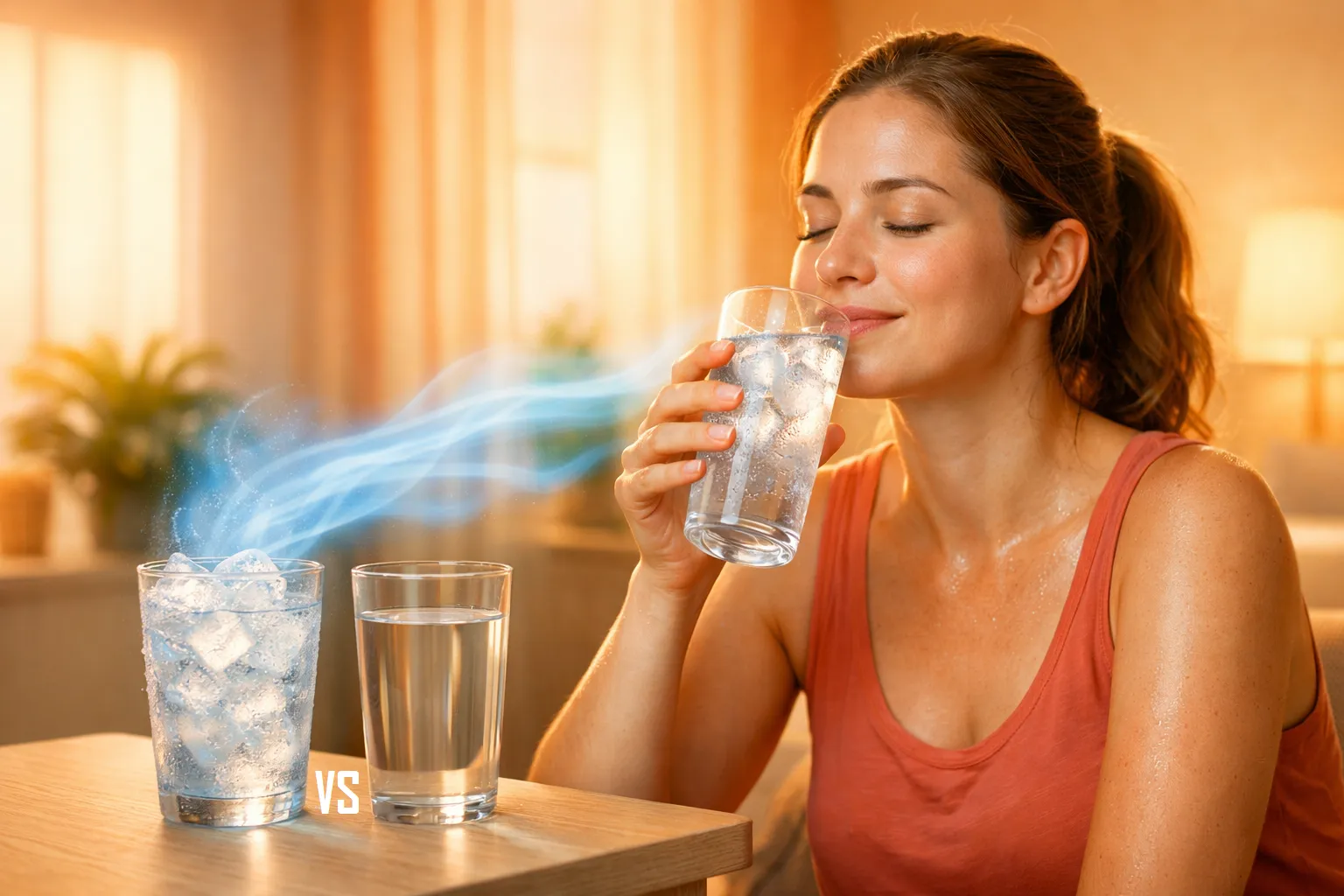
On a scorching afternoon, instinct tells us to reach for the coldest drink available. But is this purely psychological comfort — or is there real thermodynamic science behind why a chilled beverage cools you faster than one sitting at room temperature?
- The Thermodynamics of Cooling
- How the Body Regulates Temperature
- How Cold Drinks Actually Work Inside the Body
- Scientific Mechanism — Core Temperature Reduction
- Water’s Exceptional Heat Capacity
- Thermal Energy Absorbed — Cold Water vs. Room Temperature
- Cold vs. Room Temperature: A Direct Comparison
- Cold Drinks and Exercise Performance
- Common Myths Debunked
- Optimal Drinking Strategy for Cooling
- Key Takeaways
The Thermodynamics of Cooling
At the most fundamental level, cooling is the transfer of thermal energy — heat — from a warmer object to a cooler one. When you drink a cold beverage, you are introducing a thermal “sink” into your body’s internal environment. The temperature differential between your body (approximately 37°C / 98.6°F) and the cold drink (typically 4–10°C) drives the transfer of heat from your tissues into the liquid.
You might also like: What Drinks Hydrate You the Most?
This process is governed by the zeroth and second laws of thermodynamics: heat naturally flows from regions of higher temperature to lower temperature until equilibrium is reached. The greater the temperature difference, the faster and more efficient this energy transfer.
| Normal core body temperature | Typical cold drink temperature | Temperature differential driving heat transfer | Specific heat capacity of water |
|---|---|---|---|
| 37°C | ~4°C | 33°C | 4.18 J/g°C |
How the Body Regulates Temperature
The human body is a masterful thermoregulator. Core temperature is maintained within a narrow range (36.5–37.5°C) through a coordinated system involving the hypothalamus, skin, sweat glands, and circulatory system. When internal temperature rises — due to exercise, fever, or environmental heat — the hypothalamus initiates cooling responses: cutaneous vasodilation (widening of blood vessels near the skin), sweating, and reduced metabolic heat production.
These mechanisms all carry a physiological cost — energy expenditure, fluid loss, and cardiovascular strain. Introducing a cold drink directly supplements the body’s cooling apparatus through a different, more direct channel: internal conductive cooling.
“The gastrointestinal tract is richly vascularized. Heat absorbed by cold water in the stomach is rapidly transported away via the portal circulation, directly influencing blood temperature.”
How Cold Drinks Actually Work Inside the Body
When cold water passes through your mouth and esophagus, it begins absorbing heat immediately from the surrounding mucosal tissues. The oral cavity and throat are densely packed with blood vessels, and pre-cooling begins even before the liquid reaches the stomach.
Stage 1 — Oral and Esophageal Cooling
The mucosal lining of the mouth and esophagus has high thermal conductivity due to rich blood perfusion. Cold liquid traveling through these passages draws heat from the blood circulating just beneath the surface, slightly lowering the temperature of venous blood returning toward the heart.
You might also like: Can Slushies Hydrate You?
Stage 2 — Gastric Heat Absorption
Once in the stomach, cold water is surrounded by highly vascular gastric walls. The stomach acts as a heat exchange chamber, where the cold liquid absorbs significant thermal energy from the gastric mucosa and the blood perfusing it. Studies have shown core temperature can be measurably reduced within minutes of drinking cold water, particularly during exercise.
Stage 3 — Circulatory Distribution
Blood cooled by the gastrointestinal tract returns to the heart via the portal and systemic circulation, distributing cooler blood throughout the body. This is the mechanism that makes cold water drinking a viable strategy for athletes and workers in hot environments.
Scientific Mechanism — Core Temperature Reduction
Research published in the British Journal of Sports Medicine demonstrated that ingesting cold water (4°C) during exercise reduced core body temperature by 0.4–0.7°C compared to thermoneutral water (37°C). This may seem modest, but in hyperthermic states, even fractional reductions in core temperature can significantly delay the onset of heat exhaustion and improve performance capacity.
Water’s Exceptional Heat Capacity
A key reason cold water is such an effective cooling agent is water’s extraordinarily high specific heat capacity: 4.18 joules per gram per degree Celsius (J/g°C) — the highest of any common liquid. This means water can absorb a large amount of thermal energy per unit mass before its own temperature rises appreciably.
When you drink 500 ml of water at 4°C, as that water warms to body temperature (37°C), it must absorb:
Thermal Energy Absorbed — Cold Water vs. Room Temperature
| Parameter | Cold Water (4°C) | Room Temp Water (25°C) |
|---|---|---|
| Volume consumed | 500 ml | 500 ml |
| Initial temperature | 4°C | 25°C |
| Temperature rise to 37°C | 33°C | 12°C |
| Heat absorbed from body *(Q = mcΔT) | ~69,000 J (69 kJ) | ~25,000 J (25 kJ) |
| Cooling effect relative to body | 2.76× more effective | Baseline |
* Formula: Q = m × c × ΔT (mass × specific heat × temperature change). These are approximate values for illustrative purposes.
This calculation reveals the stark physical reality: drinking 500 ml of cold water (4°C) draws nearly three times more heat from your body than the same volume at room temperature (25°C). The cold water simply has far more “thermal headroom” to absorb heat before equilibrating with body temperature.
You might also like: Drinks That Must Be Avoided in Hot Weather
Cold vs. Room Temperature: A Direct Comparison
Several well-designed studies have directly compared the physiological effects of cold and thermoneutral beverages, particularly in the context of exercise and heat stress.
Key Research Findings
- Mundel et al. (2006) — Published in the Journal of Sports Sciences, this study found that cyclists who consumed cold water (4°C) during exercise in the heat maintained lower core temperatures and higher performance output compared to those consuming thermoneutral water (37°C), despite equal hydration levels.
- Lee et al. (2008) — Research in Medicine & Science in Sports & Exercise confirmed that cold water ingestion reduced perceived exertion and thermal discomfort during prolonged exercise, independent of actual core temperature changes — suggesting both physiological and psychological cooling mechanisms.
- Siegel et al. (2012) — A landmark study in the British Journal of Sports Medicine demonstrated that pre-cooling with ice slurry ingestion (approximately –1°C) before exercise reduced core temperature more effectively than cold water alone, extending heat tolerance and exercise duration by up to 19%.
Cold Drinks and Exercise Performance
The application of cold-water ingestion for athletes exercising in hot environments has been studied extensively. Hyperthermia — dangerously elevated body temperature — impairs neuromuscular function, cognitive performance, and cardiovascular efficiency. Cold water ingestion represents a practical, non-invasive strategy to counteract these effects.
Athletes who pre-cool with cold beverages before competing in hot conditions have shown measurable improvements in time-to-exhaustion, power output, and decision-making speed. This is particularly relevant in endurance sports — marathon running, cycling, football — where sustained thermoregulation is critical to performance and safety.
Sports Nutrition Guidance — Optimal Hydration Protocol
- Consume 400–600 ml of cold water (4–10°C) in the 20–30 minutes before exercise in heat
- During activity, drink 150–250 ml of cold water every 15–20 minutes
- Ice slurry beverages (approximately –1°C) provide superior pre-cooling versus cold water alone
- Avoid excessive volumes that cause gastric discomfort — cold water does not cause cramping at reasonable volumes
Common Myths Debunked
Myth 1 — Cold drinks cause stomach cramps during exercise
Moderate consumption of cold water (up to 250 ml per serving) during exercise has not been shown to cause gastrointestinal cramping in healthy individuals. Cramping is more often associated with dehydration, heat stress, or electrolyte imbalance than drink temperature.
Myth 2 — Room-temperature water is absorbed faster
Gastric emptying rate — how quickly fluids move from the stomach into the small intestine for absorption — is only marginally affected by temperature at physiologically relevant ranges. Both cold and room-temperature water are absorbed effectively. The cooling benefit of cold water does not come at a cost to hydration speed under normal conditions.
Myth 3 — Cold drinks slow metabolism dangerously
While the body does expend a small amount of energy warming cold water to body temperature (this is factored into some “cold water calorie burn” claims), the metabolic effect is minimal and poses no health risk. The body does not “shut down” digestion in response to cold beverages.
Myth 4 — Hot drinks cool you better in hot weather
This claim, sometimes attributed to folk wisdom, posits that hot drinks trigger sweating that cools you more efficiently than the drink’s heat adds to the body. While there is a small kernel of physiological truth in specific low-humidity conditions, research consistently shows that cold beverages are more effective at reducing core temperature across real-world scenarios, including humid climates where evaporative cooling is impaired.
Optimal Drinking Strategy for Cooling
Understanding the science allows us to make smarter choices, particularly in high-heat environments, during exercise, or when managing fever.
| Scenario | Recommended Temperature | Rationale |
|---|---|---|
| Casual hot day hydration | Cold (4–10°C) | Maximum heat absorption per volume consumed |
| Exercise in heat (>25°C ambient) | Very cold / ice Slushie | Pre- and mid-exercise core cooling, extended performance |
| Post-exercise recovery | Cold (10–15°C) | Cooling + adequate gastric absorption rate |
| Fever management (adults) | Cold to cool (10–20°C) | Gentle internal cooling, comfort, hydration maintenance |
| Sore throat / irritation | Lukewarm to room temperature | Cold may cause temporary mucosal vasoconstriction and discomfort |
Key Takeaways
- Cold drinks cool the body faster due to a greater temperature differential and the high specific heat capacity of water
- 500 ml of cold water (4°C) absorbs nearly 3× more heat from your body than the same volume at room temperature (25°C)
- Cooling occurs in stages: oral cavity, esophagus, stomach, and systemic circulation
- Cold water ingestion has measurable, scientifically documented benefits for athletic performance in heat
- Common concerns about cold drinks causing cramps or slowing absorption are largely unsupported by clinical evidence
References & Sources
- Mundel T, et al. (2006). “Effects of drink temperature and voluntary drinking on performance, perception, and core temperature during exercise in warm, humid conditions.” Journal of Sports Sciences, 24(4), 339–345. doi:10.1080/02640410500162905
- Lee JKW, et al. (2008). “Cold water immersion and recovery from strenuous exercise: a meta-analysis.” Medicine & Science in Sports & Exercise, 40(1), 198–207. doi:10.1249/mss.0b013e3181503771
- Siegel R, et al. (2012). “Ice slurry ingestion increases core temperature capacity and running time in the heat.” British Journal of Sports Medicine, 46(1), 6–10. doi:10.1136/bjsm.2009.065490
- Nimmo MA. (2004). “Exercise in the cold.” Journal of Sports Sciences, 22(10), 898–916. doi:10.1080/02640410400005795
- Casa DJ, et al. (2000). “National Athletic Trainers’ Association Position Statement: Fluid replacement for athletes.” Journal of Athletic Training, 35(2), 212–224. PMID: 16558633
- Kenefick RW & Cheuvront SN. (2012). “Hydration for recreational sport and physical activity.” Nutrition Reviews, 70(S2), S137–S142. doi:10.1111/j.1753-4887.2012.00523.x
- Bain AR, et al. (2012). “Cold drink ingestion improves exercise capacity in the heat.” Medicine & Science in Sports & Exercise, 44(1), 50–55. doi:10.1249/MSS.0b013e318228b9fd
- Atkins WC, et al. (2019). “Cold water ingestion as a pre-exercise and per-exercise cooling strategy.” International Journal of Sports Physiology and Performance, 14(3), 393–399.
- American College of Sports Medicine. (2007). “Exercise and Fluid Replacement Position Stand.” Medicine & Science in Sports & Exercise, 39(2), 377–390. doi:10.1249/mss.0b013e31802ca597
- Coso JD, et al. (2013). “Effects of pre-exercise ingestion of different amounts of cold water on metabolic and physiological responses to exercise.” European Journal of Applied Physiology, 113(7), 1971–1981.
* Article reviewed against peer-reviewed literature. All physiological values represent general adult population averages. Consult a qualified physician or sports medicine professional before making significant changes to hydration practices, particularly for clinical applications.