
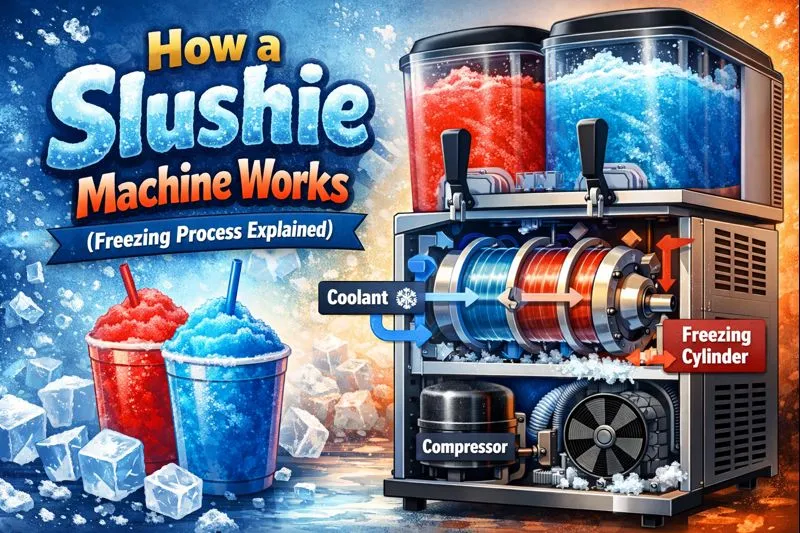
Picture this: it’s a scorching summer afternoon, and you’re craving something cold and refreshing. You walk into a convenience store and see those mesmerizing cylindrical machines with brightly colored slush swirling around inside. You’ve probably wondered how that liquid magically transforms into that perfect slushy consistency—not quite frozen solid, but not liquid either. The truth is, most people have no idea about the fascinating science and engineering behind these machines. Without understanding how slushie machines work, you might struggle to maintain one properly if you own a business, or you might not appreciate the complexity of what seems like a simple frozen beverage. The good news? The freezing process behind slushie machines is actually a brilliant combination of refrigeration technology, physics, and continuous motion that anyone can understand once it’s broken down into simple terms.
What Exactly Is a Slushie?
Before diving into how the machine works, it’s important to understand what a slushie actually is from a scientific standpoint. A slushie is a semi-frozen beverage that exists in a unique state between liquid and solid. It consists of tiny ice crystals suspended in a liquid solution, typically containing water, sugar, and flavoring. This specific consistency is what makes slushies so appealing—they’re cold enough to be refreshing but still drinkable through a straw.
You might also like: Slushy vs. Smoothie
The key to achieving this texture lies in the concentration of the liquid mixture. Pure water freezes at 32°F (0°C), but when you add sugar and other ingredients, the freezing point drops significantly. This phenomenon is called freezing point depression. A typical slushie mixture might freeze at around 28°F (-2°C) instead. This lower freezing point, combined with constant agitation, prevents the mixture from freezing into a solid block of ice and instead creates those desirable small ice crystals.
The magic happens when the mixture is kept at a temperature right at its freezing point while being continuously stirred. This prevents large ice crystals from forming and maintains that perfect slushy consistency that people love. Too cold, and you get a solid block. Too warm, and you just have flavored liquid. The slushie machine’s job is to maintain this delicate balance constantly.
The Main Components of a Slushie Machine
To understand how a slushie machine works, you need to know its essential parts. While different models and manufacturers may have variations, most slushie machines share these fundamental components that work together to create the perfect frozen beverage.
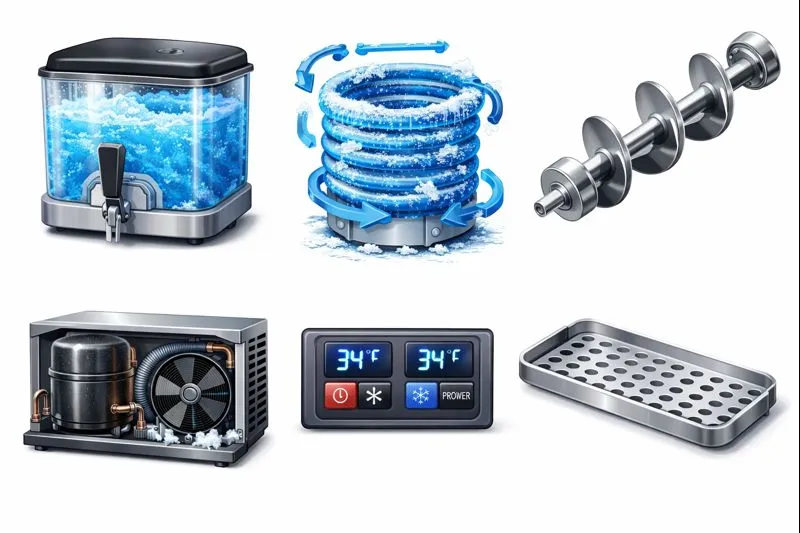
Transparent Cylinder or Bowl
The transparent cylinder or bowl is the most visible part—this is where the magic happens. Made from durable plastic or polycarbonate, this container holds the liquid mixture and allows customers to see the colorful slush inside. The bowl sits on top of the machine’s base and is typically removable for cleaning. Inside this bowl, the freezing and mixing process takes place.
The Evaporator
Wrapped around the outside of the bowl is the evaporator, which is essentially a metal cylinder or coil that gets extremely cold. This component is directly connected to the refrigeration system and is responsible for extracting heat from the liquid mixture. The evaporator is where the actual freezing occurs, as the cold metal surface causes the liquid touching it to freeze into ice crystals.
The Auger (Scraper Bar or Mixing Blade)
The auger (sometimes called a scraper bar or mixing blade) is a spiral-shaped blade inside the bowl that constantly rotates. This is one of the most crucial components because it scrapes ice crystals off the evaporator surface and mixes them throughout the liquid. Without this constant motion, the mixture would simply freeze solid against the cold walls. The auger is typically made from plastic and is powered by a motor at the base of the machine.
The Refrigeration System
The refrigeration system sits in the base of the machine and works similarly to your home refrigerator or air conditioner. It includes a compressor, condenser, expansion valve, and refrigerant that cycles through the system. This is the heart of the machine that generates the cold temperatures needed to freeze the mixture.
The Control Panel
The control panel allows operators to adjust settings like temperature, consistency, and whether the machine is in freezing mode or just mixing mode. Modern machines often have digital displays showing the current temperature and other diagnostic information.
Additional Components
Finally, the drip tray sits at the front of the machine to catch any spills or drips when dispensing slushies, and the dispensing valve or tap is what customers use to fill their cups.
You might also like: Slush Machine Overfreezing / Too Thick – Fix
The Refrigeration Cycle: The Heart of the Freezing Process
The refrigeration cycle is the fundamental process that makes a slushie machine work. This system is based on the basic principles of thermodynamics and is similar to how refrigerators and air conditioners operate, but it’s specifically calibrated for the unique requirements of making slushies.
The cycle begins with the compressor, which is essentially a pump for refrigerant gas. The compressor takes in low-pressure refrigerant gas and compresses it into a high-pressure, high-temperature gas. This compression requires energy (electricity) and is what makes the compressor the loudest component of the machine—you’ll often hear a humming or buzzing sound coming from the base.
This hot, pressurized refrigerant gas then flows to the condenser, which is usually located at the back or bottom of the machine. The condenser consists of coils or fins that dissipate heat into the surrounding air. As the refrigerant releases its heat, it condenses from a gas into a high-pressure liquid. This is why slushie machines need proper ventilation—they’re constantly releasing heat into the room. In a hot kitchen or poorly ventilated space, a slushie machine has to work harder because it’s fighting against the ambient temperature.
Next, the liquid refrigerant passes through an expansion valve or capillary tube. This small restriction causes a sudden drop in pressure, which in turn causes the refrigerant’s temperature to plummet. The refrigerant transforms into a cold, low-pressure mixture of liquid and gas—much colder than before. This is the key transformation that enables the cooling effect.
The cold refrigerant then enters the evaporator, which wraps around or is in direct contact with the slushie bowl. As the cold refrigerant flows through the evaporator, it absorbs heat from the liquid mixture inside the bowl. This heat absorption causes the refrigerant to fully evaporate back into a gas, completing the cycle. The refrigerant then returns to the compressor, and the cycle repeats continuously.
This constant cycling of refrigerant is what maintains the cold temperature of the evaporator surface. The evaporator typically needs to be around 10-15°F colder than the desired slushie temperature to effectively freeze the mixture while it’s being stirred.
How the Freezing Process Actually Works
Now that you understand the refrigeration cycle, let’s look at exactly how the liquid mixture transforms into a slushie. This is where the physics becomes truly fascinating and where the constant motion plays a critical role.
When you first pour liquid mixture into a slushie machine, it’s at room temperature. The operator turns on the machine, which activates both the refrigeration system and the auger motor. The refrigeration system immediately begins cooling the evaporator that surrounds the bowl. Within minutes, the evaporator surface becomes cold enough to begin freezing.
The liquid mixture closest to the evaporator wall begins to lose heat. As the temperature of this thin layer of liquid drops to the freezing point, ice crystals start to form on the metal surface. If left undisturbed, this layer would continue to grow thicker and thicker, eventually creating a solid shell of ice around the inside of the bowl. This is exactly what you don’t want.
This is where the rotating auger becomes essential. The auger blade is positioned to scrape along the inside surface of the bowl, in direct contact with the evaporator. As it rotates (typically at 15-30 RPM depending on the model), it continuously scrapes off the ice crystals that form on the cold surface. These scraped ice crystals are then mixed throughout the liquid, distributing the frozen particles evenly.
This scraping and mixing process serves multiple purposes. First, it prevents large ice formations from building up, ensuring small, uniform ice crystals instead. Second, it brings warmer liquid from the center of the bowl to the cold walls, where it can be frozen. Third, it maintains a consistent texture throughout the entire bowl rather than having frozen sections and liquid sections.
As the machine continues to run, more and more ice crystals form and get distributed throughout the mixture. The ratio of ice crystals to liquid gradually increases. The machine’s thermostat monitors the temperature and consistency, adjusting the refrigeration cycle to maintain the perfect balance. Most machines are set to maintain the mixture at around 28°F (-2°C), which is cold enough to keep the ice crystals frozen but not so cold that the entire mixture solidifies.
The sugar content in the mixture is crucial to this process. Sugar molecules interfere with the formation of ice crystal lattices, preventing the mixture from freezing solid. This is why slushies must contain a minimum amount of sugar or similar solutes—typically around 12-14% sugar content. Without sufficient sugar, the mixture would freeze too hard, and with too much sugar, it wouldn’t freeze properly at all.
The Role of Continuous Agitation
The constant motion provided by the auger is just as important as the cold temperature in creating the perfect slushie. To understand why, you need to understand what happens to ice crystals under different conditions.
When water freezes without agitation, ice crystals grow large and form organized structures. This is what happens when you freeze water in an ice cube tray—you get solid chunks of ice. In a slushie machine, the goal is the opposite: you want tiny ice crystals that remain suspended in the liquid. The continuous scraping and mixing prevents crystals from growing large and ensures they stay small and uniform in size.
The agitation also serves another critical function: it incorporates air into the mixture. As the auger spins, it creates turbulence that pulls small amounts of air into the slush. This aeration contributes to the light, fluffy texture of a well-made slushie. The tiny air bubbles make the slushie less dense and give it that appealing, snow-like consistency. Without this aeration, slushies would be much denser and less pleasant to drink.
The speed of the auger is carefully calibrated. If it rotates too slowly, ice will build up on the walls faster than it can be scraped off, and the mixture will freeze unevenly. If it rotates too fast, it can generate friction heat that partially melts the ice crystals, resulting in a mixture that’s too watery. Most machines operate at a speed that provides optimal scraping without generating excessive heat.
Interestingly, the auger also acts as a mixing tool that keeps the flavors distributed evenly. In a multi-flavor machine where you might pour in additional syrup, the auger ensures that new ingredients get thoroughly incorporated rather than settling in layers.
Temperature Control and Thermostats
Precise temperature control is absolutely critical to maintaining the perfect slushie consistency. This is managed by thermostats and temperature sensors that constantly monitor the mixture and adjust the refrigeration cycle accordingly.
Most modern slushie machines have a thermistor or temperature probe that extends into the mixture itself or monitors the evaporator temperature. This sensor sends continuous readings to the control board, which compares the current temperature to the desired set point. If the mixture is too warm, the control board signals the compressor to run continuously, increasing cooling. If the mixture is at the right temperature, the compressor may cycle on and off to maintain that temperature without over-freezing.
The desired consistency can usually be adjusted by the operator. A “thicker” setting means the machine will maintain a slightly lower temperature, resulting in more ice crystals and a firmer slush. A “thinner” setting means a slightly warmer temperature with fewer ice crystals and more liquid. Most operators aim for a consistency that’s easy to drink through a straw but still noticeably frozen and cold.
Some advanced machines have viscosity sensors that can actually measure the thickness of the mixture mechanically. These sensors detect how much resistance the auger encounters as it rotates—thicker slush creates more resistance. This allows for even more precise consistency control than temperature alone.
The machines also typically have safety features to prevent over-freezing. If the temperature drops too low or if the mixture becomes too thick, the machine may automatically stop the refrigeration system or even shut down entirely to prevent damage to the auger motor or other components.
Why the Mixture Composition Matters
The chemical composition of your slushie mixture is just as important as the machine’s mechanics. Different ingredients affect how the mixture freezes and what final consistency you achieve.
As mentioned earlier, sugar is crucial for freezing point depression. But it’s not just about the amount—the type of sugar matters too. Sucrose (table sugar) is most common, but high-fructose corn syrup, glucose, and other sweeteners all have slightly different effects on freezing point and texture. Some commercial slushie bases use a carefully calibrated blend of different sugars to achieve optimal freezing characteristics.
The water content is another critical factor. Most slushie mixtures are predominantly water (70-80%), which is what actually freezes into ice crystals. If there’s too little water, you won’t get enough ice formation. If there’s too much water and not enough dissolved solids, the mixture will freeze too hard.
Flavorings and acids (like citric acid) also play a role. These ingredients not only provide taste but can affect the freezing point and the size of ice crystals that form. Some acidic ingredients can make the mixture freeze slightly softer, while others might make it firmer.
Many commercial slushie suppliers provide pre-mixed concentrates that are scientifically formulated to freeze at exactly the right temperature and create the perfect texture. These aren’t just sugar and flavor—they often contain stabilizers, emulsifiers, and other additives that ensure consistent results. If you were to just put fruit juice or soda in a slushie machine, you likely wouldn’t get good results because the composition isn’t optimized for this freezing method.
Different Operating Modes
Most commercial slushie machines have multiple operating modes that serve different purposes throughout the day. Understanding these modes helps explain how the machines adapt to different situations.
Freeze mode is the primary operating mode where both the refrigeration system and the auger are running continuously. This is used when initially freezing liquid mixture and when maintaining the slushie during normal business hours. In this mode, the machine constantly monitors temperature and adjusts cooling to maintain the perfect consistency.
Preserve or storage mode is used during slow periods or overnight. In this mode, the auger might stop rotating or rotate only periodically (every few minutes), while the refrigeration system maintains a colder temperature. This keeps the mixture frozen solid for storage without wasting energy on constant agitation. When you’re ready to serve again, you switch back to freeze mode, and the auger breaks up the solid frozen mixture back into slushie consistency.
Mix or defrost mode runs the auger without refrigeration. This is useful for mixing in new ingredients or for gradually bringing an over-frozen mixture back to proper consistency. The auger’s motion and friction will gently warm an overly frozen batch.
Some machines also have a night mode or energy-saving mode that reduces power consumption during off-hours while still keeping the product frozen and preventing spoilage.
Common Issues and How the Machine Compensates
Even with perfect engineering, slushie machines face various challenges throughout operation. Understanding these issues helps explain some of the more sophisticated features built into modern machines.
One common problem is uneven freezing. If the refrigeration system is too powerful or the mixture isn’t moving properly, you can get chunks of solid ice mixed with liquid. Modern machines combat this with variable-speed compressors that can adjust cooling power and with augers designed to create optimal flow patterns throughout the bowl.
Another issue is “bridging,” where a dome of frozen mixture forms over the auger, preventing proper mixing. This can happen if the mixture is over-frozen or if there’s too much product in the bowl. Machines typically prevent this with torque sensors that detect when the auger is struggling and automatically adjust temperature or alert the operator.
Ambient temperature affects performance significantly. On a hot day, the machine has to work harder because heat is constantly being conducted into the mixture through the bowl walls and through the exposed top. High-quality machines have extra insulation and more powerful compressors to handle these conditions. Some even have sensors that detect ambient temperature and adjust their operation accordingly.
Product dilution from melted ice is another concern in busy settings. Each time someone dispenses a slushie, warm air enters the bowl, and the product level drops. The machine compensates by running the refrigeration more aggressively after dispensing. Operators also need to regularly top off the bowl with fresh mixture to maintain proper levels.
The Science Behind the Perfect Texture
The ideal slushie texture is more than just frozen liquid—it’s a carefully engineered state of matter. The ice crystals in a perfect slushie are typically 10-50 micrometers in size. Crystals in this size range are small enough to create a smooth texture but large enough to give that satisfying icy feeling.
The distribution of these crystals throughout the liquid is also important. You want a relatively uniform distribution rather than having all the ice sink to the bottom or float to the top. The density difference between ice and liquid would normally cause separation, but the constant agitation keeps everything mixed together.
The ratio of ice to liquid in a properly made slushie is typically around 40-50% ice by volume. This ratio provides that perfect balance where the drink is obviously frozen and icy but still flows easily and can be consumed through a straw. More ice than this becomes too hard to drink, while less ice makes it too watery and not refreshing enough.
The incorporation of air also affects texture significantly. A well-made slushie might contain 10-20% air by volume (called overrun in food science terminology). This aeration makes the slushie lighter and fluffier rather than dense and icy. It’s the same principle used in making ice cream smooth instead of hard and chunky.
You might also like: How To Make a Slushie at Home
Energy Efficiency and Modern Innovations
Modern slushie machines are significantly more energy-efficient than older models, thanks to several technological advances. Understanding these innovations shows how the basic freezing process has been optimized over time.
Variable-speed compressors can adjust their cooling output based on actual need rather than simply cycling on and off. This provides more precise temperature control while using less electricity. When the mixture is close to the target temperature, the compressor can run at lower speed rather than turning completely off, reducing the wear and tear from constant starting and stopping.
Improved insulation around the bowl and evaporator reduces heat transfer from the environment, meaning the refrigeration system doesn’t have to work as hard to maintain cold temperatures. Some modern machines use vacuum insulation similar to high-end thermoses.
Smart controls with microprocessors can learn usage patterns and adjust operation accordingly. For example, if the machine knows that business is typically slow from 2-4 PM, it might automatically adjust to a lower power mode during those hours without operator input.
LED lighting has replaced older fluorescent or halogen lights in the bowl illumination, dramatically reducing energy consumption while making the product look even more appealing to customers.
Some cutting-edge machines even have predictive algorithms that anticipate when more product will be needed based on past dispensing patterns and ambient conditions, adjusting their freezing cycle proactively rather than reactively.
Conclusion
A slushie machine is far more sophisticated than it might appear. What looks like a simple process of freezing liquid is actually a precise dance of thermodynamics, refrigeration engineering, mechanical mixing, and chemistry. The machine must maintain exact temperatures, constantly agitate the mixture to prevent solid freezing, incorporate air for texture, and adapt to changing conditions throughout the day.
The key to the perfect slushie lies in maintaining that delicate balance where ice crystals continuously form and are immediately scraped off and distributed throughout the mixture. Too much freezing creates an icy, hard product that’s difficult to drink. Too little freezing leaves you with flavored water. The constant rotation of the auger, combined with precise temperature control, creates that signature slushie texture that’s both frozen and drinkable. Understanding how these machines work gives you an appreciation for the engineering behind a product most people take for granted. Whether you’re considering purchasing a machine for your business, maintaining one, or simply satisfying your curiosity, knowing the science behind the swirl makes that next slushie taste even better. The next time you see those mesmerizing cylinders of colorful frozen beverage slowly churning away, you’ll know exactly what’s happening inside—and why it works so perfectly.