A slushie machine not freezing properly is one of the most common and frustrating problems for both commercial and home users. The slush stays liquid, the texture feels uneven, and customers or guests leave disappointed—especially during summer, when chilled drinks are most popular.
If ignored, this issue can lead to overheating, leakage, poor performance, higher repair cost, and even equipment failure or safety hazards like electrical shorts. Dirty coils, incorrect syrup ratio, blocked airflow, or faulty settings quietly reduce the machine’s efficiency over time.
The good news? Most slushie machine not freezing problems have clear causes and practical fixes. This guide covers accurate diagnostics, step-by-step solutions, and professional tips to restore proper freezing, consistency, and reliability.
- How a Slushie Machine Freezes (Quick Overview)
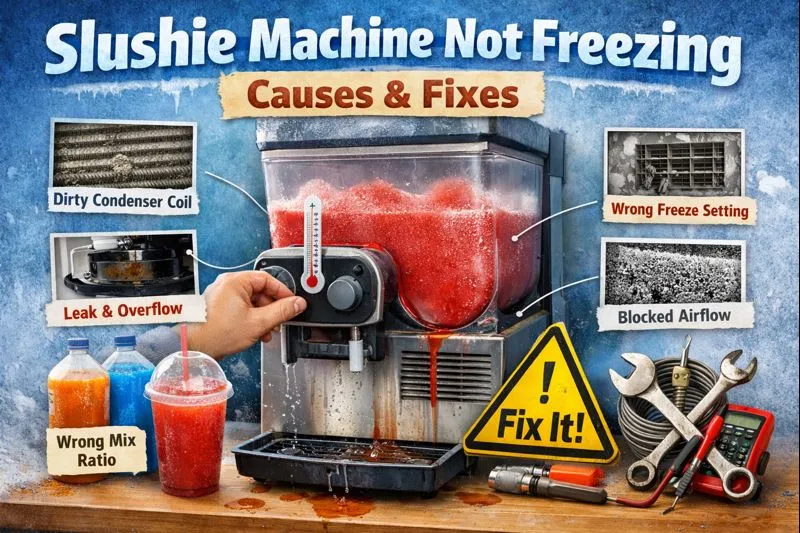
- Main Causes & Fixes for a Slushie Machine Not Freezing
- 1. Overheating and Automatic Shutdown
- 2. Machine Leaking or Overflow Outlet Leaking
- 3. Airflow Problems or Blocked Intake
- 4. Dirty or Blocked Condenser Coil
- 5. Incorrect Syrup Ratio or Poor Dilution
- 6. Freeze Setting Needs Adjustment
- 7. Freezing on the Outside (Frost & Condensation)
- 8. Mechanical Problems (Noise, Clicking, Squeaking)
- 9. Electrical Problems Preventing Freezing
- 10. Poor Cleaning, Hygiene & Bacteria Buildup
- When to Call a Pro (If Quick Fixes Fail)
- FAQs – Slushie Machine Freezing Issues
- Final Verdict
How a Slushie Machine Freezes (Quick Overview)
A slushie machine relies on a refrigeration system where the compressor, evaporator, condenser-coil, fan, and cooling cycle work together. The mixture rotates inside the barrel using a spiral agitator, while controlled temperature (usually between -2°C to -5°C) creates smooth, frozen slush.
Any issue with airflow, dilution, cleaning, or mechanical components can interrupt freezing.
Main Causes & Fixes for a Slushie Machine Not Freezing
1. Overheating and Automatic Shutdown
Cause:
Dirty coils, airflow restriction, extended runtime, or faulty fan cause thermal overload.
Fix:
- Clean condenser and fan blades
- Allow cooldown periods
- Avoid overnight continuous operation
2. Machine Leaking or Overflow Outlet Leaking
Cause:
Worn seals, damaged O-Rings, loose fittings, cracked gaskets, or blocked outlet-drain.
Fix:
- Inspect leakage-source carefully
- Tighten connections and valves
- Replace worn seals-head or damaged parts
3. Airflow Problems or Blocked Intake
Cause:
Restricted airflow-path, blocked intake, poor ventilation, or cluttered placement causes overheating.
Fix:
- Relocate the machine to a shady, clutter-free area
- Ensure proper room ventilation
- Clean or replace filters
4. Dirty or Blocked Condenser Coil
Cause:
Dust, debris, and residue clog the condenser-coil, trapping heat and reducing cooling efficiency.
Fix:
- Power off and unplug the machine
- Clean coils weekly using a soft brush
- Keep the radiator side clear with at least 40 cm clearance
5. Incorrect Syrup Ratio or Poor Dilution
Cause:
Wrong 6:1 syrup-to-water ratio, excessive dilution, expired ingredients, or low sugar balance affect viscosity and prevent freezing.
Fix:
- Follow the manufacturer recipe exactly
- Use quality syrup from a trusted supplier
- Mix ingredients well before pouring into the tank
- Avoid refilling with warm liquid
6. Freeze Setting Needs Adjustment
Cause:
Incorrect freeze setting, faulty thermostat, or misaligned controls result in underfreezing.
Fix:
- Adjust temperature to -2°C to -5°C
- Use a thermometer to verify accuracy
- Reset controls according to the manual
7. Freezing on the Outside (Frost & Condensation)
Cause:
High humidity, poor insulation, or uneven cooling creates exterior frost and condensation.
Fix:
- Improve airflow and placement
- Check bowl alignment and chamber integrity
- Reduce room moisture levels
8. Mechanical Problems (Noise, Clicking, Squeaking)
Cause:
Bent blades, worn belt, stiff rotation, shaft misalignment, or lack of lubrication.
Fix:
- Lubricate agitator regularly
- Tighten or replace belt
- Replace cracked or worn mechanical parts
9. Electrical Problems Preventing Freezing
Cause:
Loose wiring, blown fuse, defective switch, broken cord, or voltage mismatch.
Fix:
- Inspect wiring and connections
- Replace blown fuse or faulty thermostat
- If unsure, contact a professional technician
Safety Note: Electrical faults can cause fire hazards—do not DIY complex repairs.
10. Poor Cleaning, Hygiene & Bacteria Buildup
Cause:
Dirty chambers, syrup residue, blocked valves, and poor sanitization reduce cooling efficiency.
Fix:
- Clean tanks with warm soapy water
- Use food-safe sanitizer and disinfecting solutions
- Follow regular hygiene and maintenance guidelines
When to Call a Pro (If Quick Fixes Fail)
If basic troubleshooting, cleaning, and adjustments do not restore proper freezing, it’s time to involve a professional technician. Some problems go beyond routine maintenance and require specialized tools, exact diagnostics, and trained handling.
Call a pro if you notice any of the following:
- The compressor does not start, keeps clicking, or shuts down repeatedly
- Suspected gas or refrigeration system failure
- Persistent electrical problems such as blown fuses, short circuits, or defective thermostat
- Continuous overheating even after cleaning the condenser and improving airflow
- Loud mechanical noise from the motor, shaft, or internal components
- Repeated leakage despite replacing seals, gaskets, or valves
- Control board, solenoid, or printed layout issues that affect settings and operation
Certified professionals can safely inspect internal components, verify voltage, check refrigerant pressure, and replace worn or damaged parts without risking further damage, fire hazard, or loss of equipment reliability.
Tip: Always choose a technician approved by the manufacturer or a trusted service provider to protect performance, safety, and long-term efficiency.
FAQs – Slushie Machine Freezing Issues
Why is my slushie machine not freezing after cleaning?
If a slushie machine is not freezing after cleaning, the most common reason is moisture, incorrect reassembly, or airflow restriction. Wet condenser coils, misplaced filters, loose connections, or excess water inside the barrel can interrupt the cooling cycle.
Always let parts dry completely, check seals and O-Rings for proper fitting, and ensure the air intake and ventilation path are clear before restarting operation.
Why is my slushie machine not?
Across brands like SYINTAO, VEVOR, GBG, ICEMAN, INOVIVA, and NINJA, freezing problems usually come from the same causes:
- Incorrect syrup-to-water ratio
- Wrong freeze setting or thermostat adjustment
- Dirty condenser-coil or blocked airflow
- Overfilling beyond tank capacity
- Warm room temperature or poor placement
Always follow brand-specific manual instructions, especially for temperature range, mixture viscosity, and cleaning frequency.
How can I make my slushy freeze faster?
To speed up freezing:
- Avoid opening the lid frequently during freezing time
- Use the correct 6:1 syrup ratio
- Pre-chill water and ingredients
- Clean condenser coils and filters
- Ensure proper ventilation and clearance
- Set temperature between -2°C and -5°C
How do I unfreeze a slushie machine?
If the machine is over-frozen or ice-locked:
- Turn off power and unplug the unit
- Allow natural defrost at room temperature
- Do not scrape ice with sharp tools
- Drain excess liquid if needed
- Restart with adjusted freeze settings and correct mixture
This prevents damage to the evaporator, seals, and internal components.
How long does a slushie machine take to freeze?
Typically 40–60 minutes, depending on mixture, environment, and machine capacity.
Can warm room temperature affect freezing?
Yes, scorching environments reduce efficiency significantly.
Final Verdict
A slushie machine not freezing is usually caused by incorrect syrup ratio, airflow problems, dirty condenser coils, or wrong settings—not major failure. With proper diagnosis, routine maintenance, and timely adjustments, you can restore smooth, frozen drinks and ensure long-lasting reliability.
Whether for commercial queues or home summer delights, consistent care keeps your slushie machine performing at its best.