Cleaning a slush machine has always been one of the most overlooked—and most misunderstood—parts of frozen beverage operation. Many operators assume that if a machine is labeled “self-cleaning,” hygiene problems are automatically solved. Others avoid these machines altogether, believing the feature is mostly marketing with little real benefit. Both assumptions create confusion at the decision stage.
The reality is more nuanced. Slush machines operate in a warm, sugary, high-moisture environment—ideal conditions for residue buildup and microbial growth if cleaning is inconsistent or incomplete. Traditional manual cleaning is time-consuming and often skipped, while self-cleaning technology promises convenience, consistency, and improved hygiene. But what does “self-cleaning” actually mean at a mechanical level?
This article explains how self-cleaning slush machine technology works, what problems it genuinely solves, and where its limitations begin. By separating engineering reality from marketing language, this guide helps readers understand whether self-cleaning systems improve sanitation, reduce labor, or simply shift responsibilities. No products are promoted—only the technology itself is examined.
- What Is Self-Cleaning Slush Machine Technology?
- Why Cleaning Slush Machines Is Technically Challenging
- Core Components of Self-Cleaning Slush Machine Systems
- What Self-Cleaning Slush Machines Do Well
- What Self-Cleaning Technology Does Not Do
- Self-Cleaning vs Manual Cleaning: A Practical Comparison
- Common Misconceptions About Self-Cleaning Slush Machines
- Who Benefits Most from Self-Cleaning Technology?
- The Bottom Line: Understanding the Technology, Not the Label
What Is Self-Cleaning Slush Machine Technology?
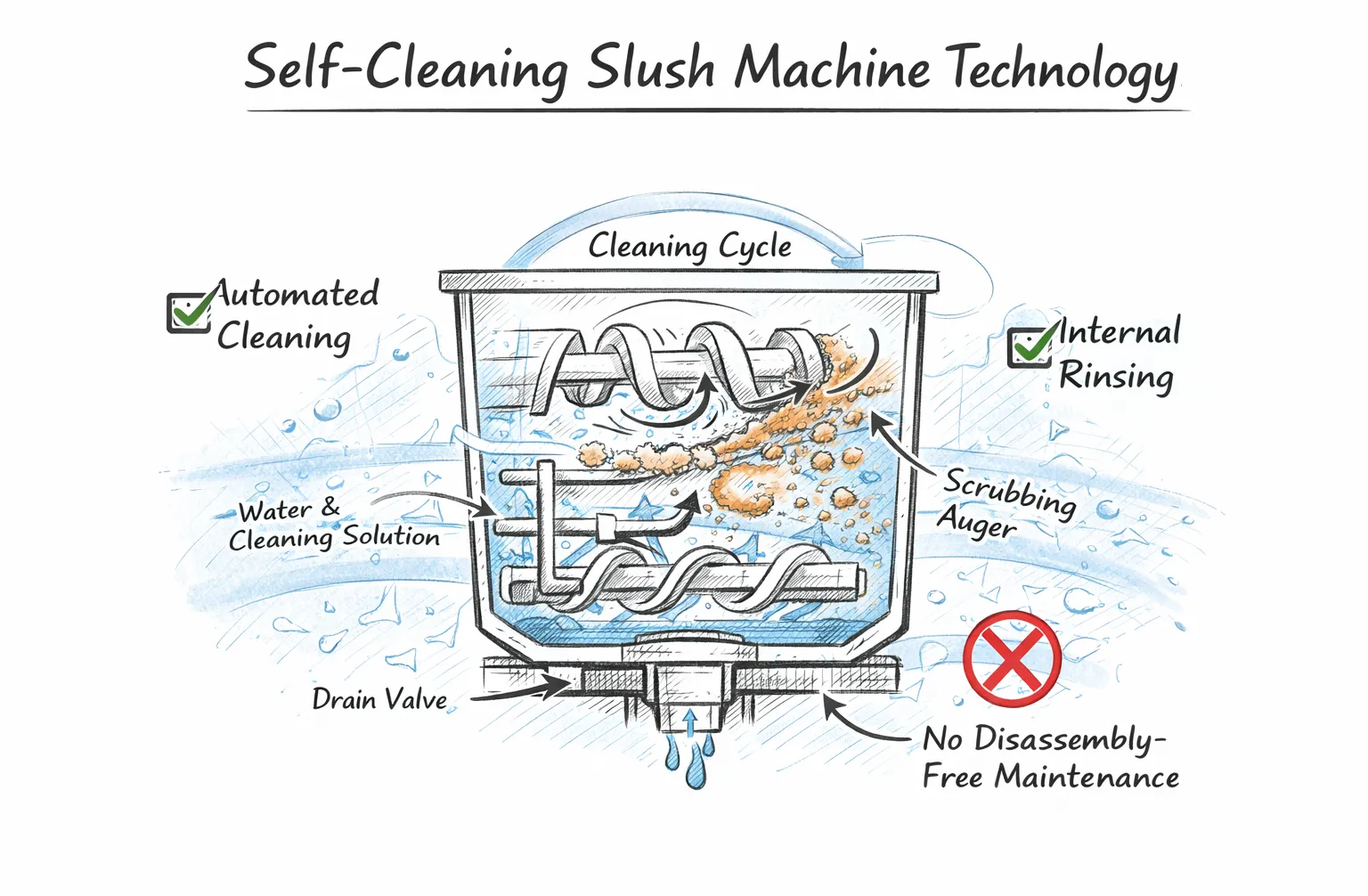
Self-cleaning slush machine technology refers to integrated mechanical and software-controlled systems designed to automate parts of the internal cleaning process. These systems typically focus on:
- Circulating cleaning solution or water through internal pathways
- Agitating residues using augers or pumps
- Flushing syrup, sugar, and ice film from contact surfaces
- Reducing the need for full manual disassembly between cycles
Importantly, self-cleaning does not mean self-sanitizing without human involvement. The technology assists cleaning, but does not eliminate responsibility.
At its core, this technology is about process consistency—ensuring that critical internal areas are rinsed and flushed regularly, even when staff shortcuts might otherwise occur.
Why Cleaning Slush Machines Is Technically Challenging
To understand the value of self-cleaning systems, it helps to understand why slush machines are difficult to clean manually.
1. Sugar and Syrup Adhesion
Slush syrups contain:
- High sugar concentrations
- Food dyes
- Acids and flavor compounds
When exposed to cold surfaces, these ingredients adhere strongly to evaporator walls, augers, and seals.
2. Temperature Cycling
During idle periods, internal temperatures fluctuate:
- Below freezing during operation
- Above freezing during standby
This cycle encourages residue layering rather than simple wash-off.
3. Internal Geometry
Slush machines contain:
- Narrow tubing
- Sealed chambers
- Moving augers and seals
Many of these areas are not visible or easily accessible during manual cleaning.
Self-cleaning technology was developed to address these mechanical realities—not just to save labor.
Core Components of Self-Cleaning Slush Machine Systems
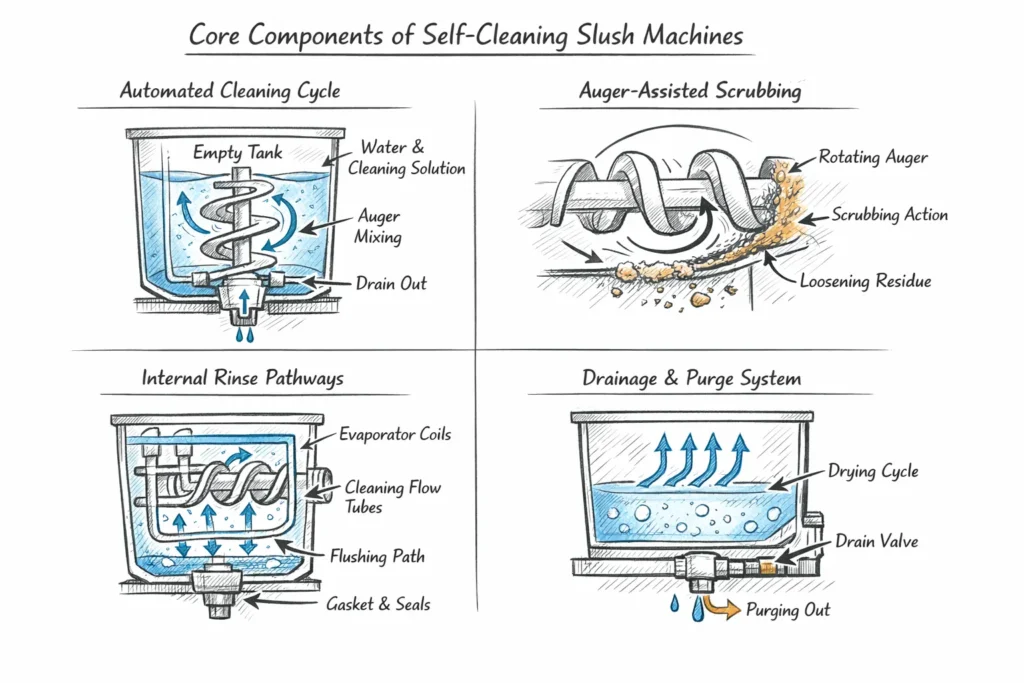
While designs vary, most self-cleaning systems rely on a combination of the following components:
1. Automated Cleaning Cycles
Machines include pre-programmed modes that:
- Drain remaining product
- Introduce water or cleaning solution
- Run augers or paddles during circulation
- Flush internal pathways
These cycles are often activated via a control panel or touchscreen.
2. Auger-Assisted Scrubbing
Instead of passive soaking, the auger rotates during cleaning, providing:
- Mechanical agitation
- Disruption of syrup films
- More effective residue release
This mimics manual brushing—without full disassembly.
3. Internal Rinse Pathways
Dedicated channels allow cleaning fluid to:
- Reach evaporator walls
- Contact seals and gaskets
- Flush dead zones where syrup pools
4. Drainage and Purge Systems
After cleaning, machines automatically:
- Expel used solution
- Reduce standing moisture
- Prepare chambers for refilling
What Self-Cleaning Slush Machines Do Well
Self-cleaning technology provides measurable advantages when properly understood and used.
Improved Cleaning Consistency
Automated cycles ensure that:
- Cleaning happens on schedule
- Key surfaces are always flushed
- Human forgetfulness is reduced
Consistency is often more important than intensity.
Reduced Labor Time
Staff no longer need to:
- Fully disassemble tanks daily
- Manually scrub every internal surface
- Spend extended downtime on cleaning
This is especially valuable in high-volume environments.
Lower Risk of Residue Buildup
Frequent internal rinsing prevents:
- Syrup crystallization
- Sticky valve formation
- Hardened sugar layers that require aggressive scrubbing
What Self-Cleaning Technology Does Not Do
This is where marketing language often creates false expectations.
It Does Not Replace Manual Deep Cleaning
Even advanced systems cannot:
- Inspect seals for wear
- Remove biofilm from hidden gasket edges
- Sanitize removable components fully
Periodic disassembly remains essential.
It Does Not Eliminate Sanitizing Requirements
Cleaning removes residue. Sanitizing kills microbes.
Most self-cleaning cycles focus on cleaning—not full sanitization.
It Does Not Fix Poor Syrup Formulation
Improper syrup ratios can still cause:
- Over-thick residue
- Freezing imbalance
- Excessive buildup—even in self-cleaning machines
Self-Cleaning vs Manual Cleaning: A Practical Comparison
| Aspect | Self-Cleaning Technology | Manual Cleaning |
|---|---|---|
| Frequency | High (daily or more) | Low to moderate |
| Labor Time | Low | High |
| Consistency | Very high | Variable |
| Depth of Cleaning | Moderate | High |
| Human Error | Reduced | Common |
The most hygienic operations combine both, not one or the other.
Hygiene, Food Safety, and Compliance Considerations
Self-cleaning systems help with:
- Routine residue control
- Surface flushing
- Moisture management
However, food safety compliance still depends on:
- Cleaning logs
- Proper sanitizer use
- Visual inspection
- Scheduled deep cleaning intervals
Regulators evaluate outcomes, not features. A self-cleaning label does not exempt any machine from hygiene standards.
Common Misconceptions About Self-Cleaning Slush Machines
- “I never need to open the machine.”
False: Internal inspection is still required. - “Self-cleaning means bacteria-free.”
False: Cleaning ≠ sanitizing. - “Any syrup works fine.”
False: Sugar concentration and additives still matter. - “More cycles mean no maintenance.”
False: Seals, augers, and motors still wear.
Who Benefits Most from Self-Cleaning Technology?
This technology is most valuable for:
- High-traffic locations
- Operations with staff turnover
- Environments where daily disassembly is unrealistic
- Businesses prioritizing consistency over perfection
It is less critical for:
- Low-volume use
- Home users comfortable with manual cleaning
- Situations where full teardown is already routine
The Bottom Line: Understanding the Technology, Not the Label
Self-cleaning slush machine technology is neither a gimmick nor a magic solution. It is a process-control tool designed to improve consistency, reduce labor, and manage residue buildup in machines that operate under demanding conditions.
When understood correctly, it complements—not replaces—manual cleaning and good formulation practices. When misunderstood, it creates false confidence and hygiene risks.
Knowing what the technology actually does is the difference between using it effectively and relying on it blindly.